Customer messages arrive across WhatsApp, Messenger, Instagram, and more, staying fast and organized gets harder as the business grows.
Case study
AI BOS CRM
An AI-powered CRM that puts an AI Employee in a business's inbox and pipeline, unifying WhatsApp, Messenger, and Instagram conversations, qualifying leads, and escalating to a human only when judgment is needed.
I owned product design, UX/UI, and the full front-end build, using AI tools throughout the build process itself.
The AI Employee handles repetitive conversations and escalates to a person only when a conversation needs human judgment.
A unified inbox, automated pipeline, and AI Employee shipped as one working product.
My contribution
- Defined the product concept: an AI Employee embedded in the inbox, pipeline, and follow-ups instead of a bolt-on chatbot feature.
- Designed and built the unified multi-channel inbox, automated pipeline board, and task/escalation views.
- Designed the human-in-the-loop escalation model that decides when the AI hands a conversation to a person.
- Directed the visual system: a blue-to-purple gradient identity over a clean, dashboard-first SaaS layout.
- Used Claude and ChatGPT throughout the build itself, architecture, coding, debugging, prompt design, and workflow logic.
Challenge
Businesses receive customer messages across WhatsApp, Messenger, Instagram, and other channels, but responding quickly and keeping those conversations organized becomes difficult as the business grows. Every additional channel and every additional lead adds more manual work, copying messages between tools, remembering who still needs a reply, and re-entering information into a pipeline by hand.
AI BOS needed to solve the speed problem at its root, an always-on first responder, without turning the product into a black box that tries to handle every conversation autonomously and gets high-stakes moments wrong.
Approach
- Centralized WhatsApp, Messenger, and Instagram conversations into one inbox instead of forcing the team to work channel by channel.
- Gave the AI Employee access to business-specific resources so it can answer questions, qualify leads, and move opportunities through the pipeline on its own.
- Built a human-in-the-loop escalation model: the AI owns repetitive interactions and hands off exactly when a conversation needs human judgment.
- Automated pipeline and task tracking, contacts, companies, deals, tasks, and follow-ups, so leads stop falling through the cracks between channels.
Information architecture
A unified inbox brings WhatsApp, Messenger, and Instagram conversations into one place, with the AI Employee handling first response day and night.
The AI uses business-specific resources to answer questions and qualify leads, moving them through the pipeline without manual data entry.
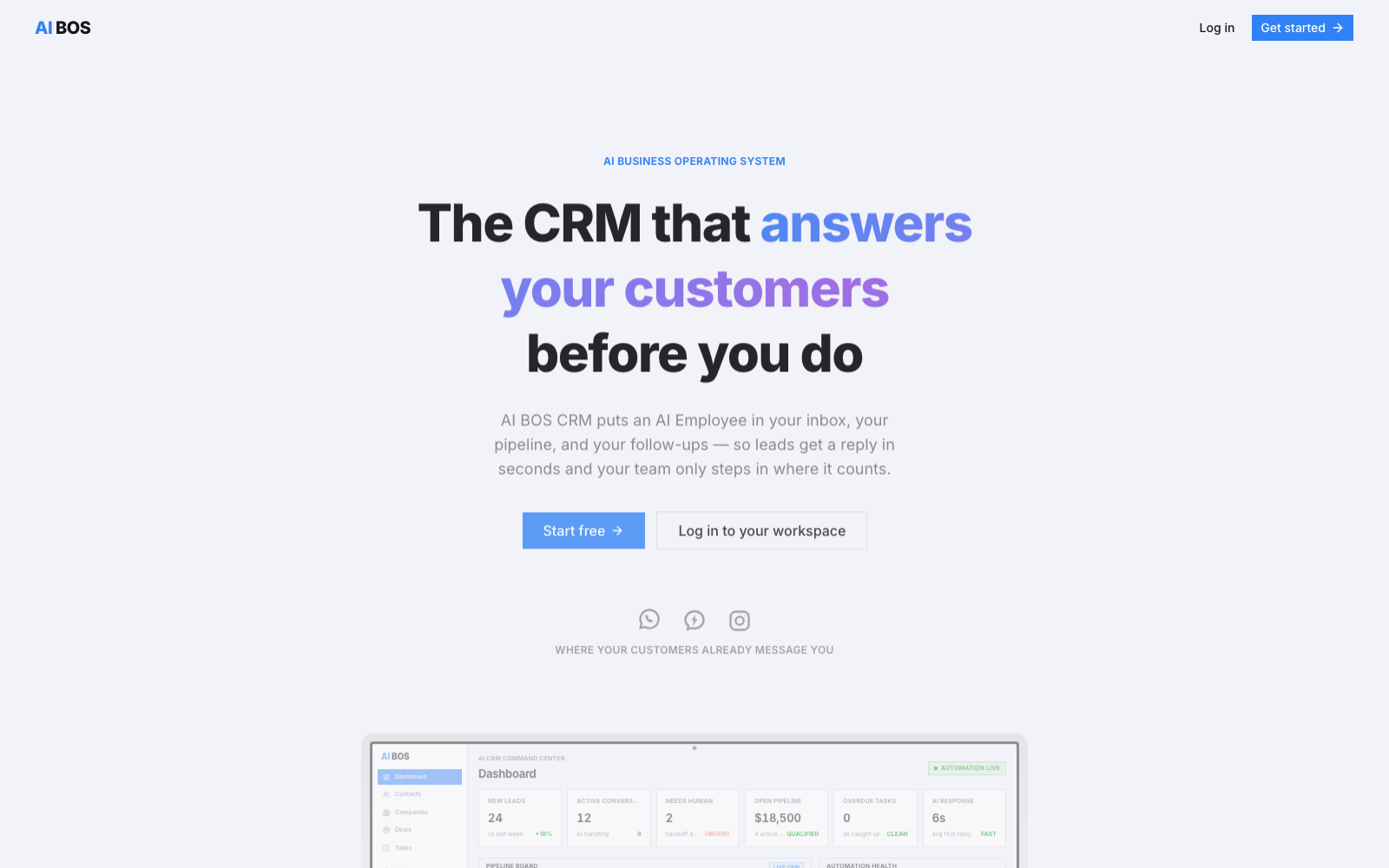
A dashboard surfaces conversations that need a human, with pipeline value, response time, and automation health visible at a glance.
Design decisions
WhatsApp, Messenger, and Instagram conversations live in one workspace, so a team never has to piece together a customer's history across separate apps.
The AI handles repetitive interactions but escalates when judgment matters, a deliberate constraint that keeps the product trustworthy instead of trying to automate everything.
New leads, active conversations, items needing human attention, open pipeline value, overdue tasks, and AI response time are surfaced together, so the state of the whole funnel is readable in one glance.
Engineering decisions
- Built the front-end with Next.js, React, and TypeScript for a type-safe dashboard and pipeline experience.
- Styled with Tailwind CSS and shadcn/ui for a consistent, accessible component system across the inbox, pipeline board, and settings.
- Used Claude and ChatGPT throughout the product-development process, architecture, coding, debugging, prompt design, and workflow logic not only as a feature inside the product.
- Designed the pipeline board and automation-health panel to make AI behavior legible: connected channels, response times, and hand-off status are always visible, not hidden behind the automation.
- Deployed on Vercel.
Visual system
The visual system uses a clean, light SaaS canvas with a blue-to-purple gradient carried through the wordmark, key headline words, and primary actions giving the "AI" positioning a literal, repeated visual signature without leaning on dark, tech-cliché styling.
The dashboard itself is treated as the product's proof: rather than illustrating the AI Employee abstractly, the landing page surfaces the real command-center layout pipeline board, automation health, and live metrics so a visitor sees the actual product, not a mockup of an idea.
Selected product direction
Outcome
AI BOS CRM launched as a complete AI-powered CRM unified inbox, automated pipeline, and human-in-the-loop AI Employee designed and built solo.
- Gave every channel an always-on first responder, addressing the response-time problem at its root instead of adding another dashboard to check.
- Reduced repetitive manual work by automating lead qualification and pipeline tracking, while keeping human judgment in the loop for high-stakes conversations.
- Used AI tools throughout the design-to-code process itself, not only as a product feature.