Many Haitian businesses sell through Instagram, Facebook, or WhatsApp, leaving buyers with no easy way to verify a vendor, compare products, pay digitally, or track delivery.
Case study
Maket Lakay
A multi-vendor marketplace foundation connecting Haitian businesses, local shoppers, and the diaspora — centralizing trust, product discovery, and diaspora care packages into one commerce ecosystem.
I owned the UX, the multi-vendor architecture, and the full front-end build through to deployment.
A dedicated bundle-building flow turns "send something home" into a first-class shopping pattern instead of an external workaround.
Category browsing, verified vendor storefronts, and a care-package flow shipped and ready to onboard real vendors.
My contribution
- Defined the trust-first product strategy behind a marketplace built on top of fragmented Instagram/Facebook/WhatsApp commerce.
- Designed and built the multi-vendor marketplace UX category browsing, vendor storefronts, cart, and checkout.
- Designed the diaspora care-package flow, a Haiti-specific buying pattern with no direct precedent in generic e-commerce templates.
- Directed the visual system: warm, trust-forward color blocking across category sections and vendor cards.
- Architected the front-end so category, cart, and checkout logic stay product-first while the data model stays ready for multi-vendor inventory, commissions, and payouts.
Challenge
The core challenge was creating an e-commerce experience able to build trust between customers and vendors while adapting to the reality of the Haitian market. Many businesses in Haiti sell through Instagram, Facebook, or WhatsApp, but that experience is often fragmented customers don't always have an easy way to verify a vendor, compare products, pay digitally, track an order, or understand how delivery works.
Maket Lakay was built to centralize that experience into a marketplace where shoppers can discover multiple vendors and products in one place, while vendors get tools to manage their storefront, products, stock, and orders. The diaspora adds a second dimension: someone in the U.S., Canada, or elsewhere needs to be able to buy a product or put together a care package for family in Haiti, pay digitally, and have the order delivered locally.
Approach
- Centralized fragmented social-commerce, Instagram, Facebook, WhatsApp into one browsable, trustworthy marketplace instead of leaving discovery scattered across channels.
- Made trust visible before checkout, not after, through verified-vendor badges, ratings, and vendor location transparency.
- Designed a diaspora-specific buying pattern care packages instead of forcing cross-border gifting into a generic cart flow built for a single shopper in one country.
- Organized categories, search, cart, and checkout around the product and the shopper's need, not around individual vendor storefronts, while keeping the underlying architecture ready for multi-vendor inventory, commissions, and payouts.
Information architecture
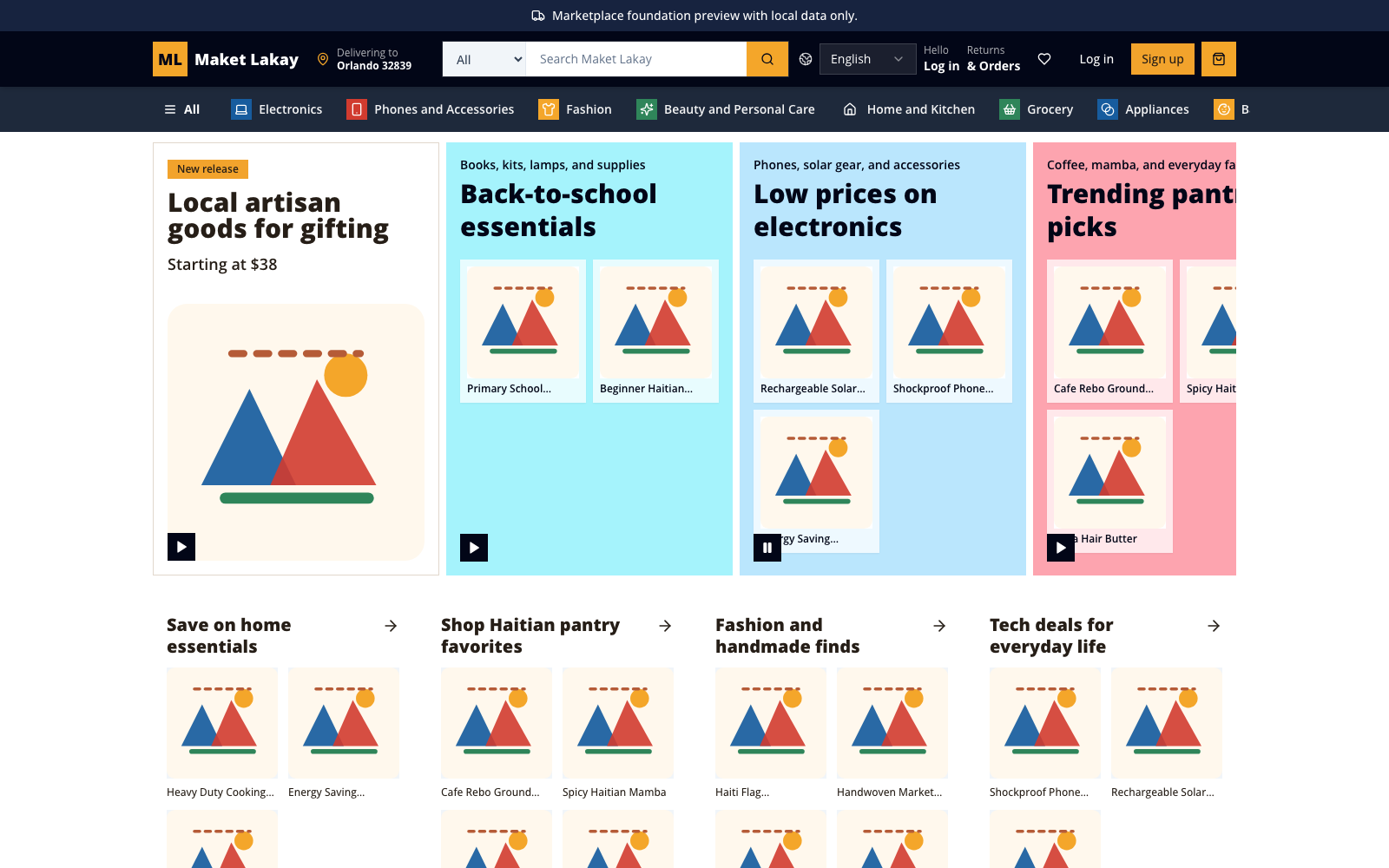
Category-based browsing across electronics, fashion, groceries, appliances, and local artisan goods, with featured, trending, and new-arrival rails.
Verified-vendor badges, ratings, and location transparency let a shopper evaluate a business before ever reaching checkout.
Diaspora care packages let a buyer abroad assemble a bundle for family in Haiti and have it delivered locally, without a separate shipping workaround.
Design decisions
Verified vendors, ratings, reviews, and clear vendor information are a core part of the experience in a marketplace where customers buy from many independent businesses, trust has to be visible before checkout, not discovered after.
Instead of buying several items separately or arranging an international shipment, a customer can choose a prepared package on Maket Lakay and have it delivered locally a merchandising decision built around a real, market-specific use case.
Categories, search, cart, and checkout are organized around the customer's product and need, so a shopper feels like they're buying from one marketplace even when items come from several vendors.
Engineering decisions
- Built the front-end with Next.js, React, and TypeScript for a type-safe, server-rendered marketplace foundation.
- Styled with Tailwind CSS and shadcn/ui for a consistent, accessible component system across category, cart, and checkout flows.
- Structured category, cart, and checkout logic around products rather than individual vendor storefronts, while keeping the data model ready for multi-vendor orders, inventory, commissions, and vendor payouts.
- Kept the architecture modular so backend services — authentication, database, payments, inventory, order management, vendor management can be connected as the product moves from foundation to full launch.
- Deployed on Vercel.
Visual system
The visual system leans warm and community-forward rather than clinical: a navy header anchors navigation and search, while category sections use bright, distinct color blocks sky blue, blush pink, warm cream so a shopper can scan "back-to-school," "trending pantry picks," or "local artisan goods" at a glance.
Language choices reinforce cultural authenticity alongside merchant-friendly clarity "Bel Lakay" (meaning "beautiful home") and "Made close to home" sit next to plain e-commerce conventions like verified badges and clear pricing, so the marketplace feels both distinctly Haitian and immediately usable.
Selected product direction
Outcome
Maket Lakay shipped as a working marketplace foundation designed and built solo ready to onboard real vendors on top of a trust-first, diaspora-aware commerce model.
- Centralized fragmented social-commerce discovery into one browsable, trustworthy marketplace.
- Reframed cross-border gifting as a native shopping pattern through the diaspora care-package flow, instead of an external workaround.
- Prepared the underlying architecture for multi-vendor inventory, commissions, and payouts ahead of onboarding real vendors.